
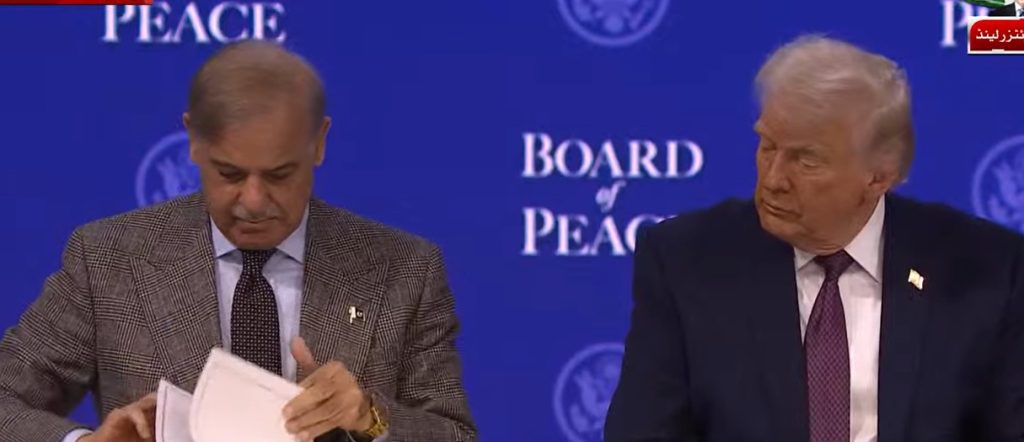
In parliament, JUI-F chief Maulana Fazlur Rehman condemned the move, arguing that expecting peace from the very forces that created the conflict was self-deception.
Pakistan’s decision to join the US-led “Board of Peace” for Gaza has quickly become one of the most contentious foreign policy moves in recent months. Signed by Prime Minister Shehbaz Sharif during the World Economic Forum in Davos, the agreement was presented by the Foreign Office as part of Islamabad’s commitment to supporting a ceasefire, humanitarian relief, reconstruction, and ultimately the establishment of an independent Palestinian state under a UN Security Council framework. Yet the announcement has triggered sharp criticism at home, with opposition parties and religious groups accusing the government of bypassing parliament and the public in making such a significant decision.
The controversy stems largely from the nature of the Board itself. Chaired for life by US President Donald Trump, the Board of Peace is designed as a transitional governing authority for Gaza, with sweeping legislative, executive, and judicial powers. Its stated mandate is to transform Gaza into a “deradicalised and demilitarised zone” that poses no threat to its neighbors. While the structure includes a Palestinian technocratic committee to handle civil administration, real authority rests with the Board and its appointed High Representative. The arrangement also involves an International Stabilisation Force initially led by the United States, with Trump retaining the power to approve or replace its commander.
Pakistan’s role in this framework is limited. It does not hold a seat on the Executive Board, meaning it has no direct influence over resolutions or military decisions. Membership is free and voluntary, but the terms of participation remain vague. This lack of clarity has fueled suspicion, especially since Israel’s Prime Minister Benjamin Netanyahu is also reported to have accepted an invitation to join the forum. For critics, Pakistan’s presence alongside Israel in a Trump-led initiative raises uncomfortable questions about principle and legitimacy.
In parliament, JUI-F chief Maulana Fazlur Rehman condemned the move, arguing that expecting peace from the very forces that created the conflict was self-deception. He warned that disarming Hamas under the plan would dismantle Palestinian resistance. Jamaat-e-Islami’s Hafiz Naeemur Rehman went further, describing the initiative as a new form of colonialism and rejecting any possibility of Pakistani troops being sent to Gaza. PTI leaders demanded transparency, insisting that the government disclose the terms of participation and consult parliament before committing to such a major international undertaking.
Government ministers, however, have defended the decision. Planning Minister Ahsan Iqbal stressed that Pakistan’s involvement does not amount to recognition of Israel, but rather reflects a diplomatic effort to strengthen peace initiatives alongside other Muslim countries. Defence Minister Khawaja Asif argued that Pakistan must participate to avoid irrelevance in future decisions, while Deputy Prime Minister Ishaq Dar dismissed speculation that Islamabad would join the stabilisation force tasked with disarming Hamas.
The debate highlights the deep divide between the government’s framing of the Board as a diplomatic opening and the opposition’s portrayal of it as a dangerous entanglement. For Pakistan, the challenge lies in balancing its longstanding support for the Palestinian cause with the risks of being drawn into a highly centralised, Trump-led experiment that many view with suspicion. Whether this participation strengthens Pakistan’s voice in international diplomacy or undermines its credibility at home remains to be seen.













Leave a Comment
Your email address will not be published. Required fields are marked with *